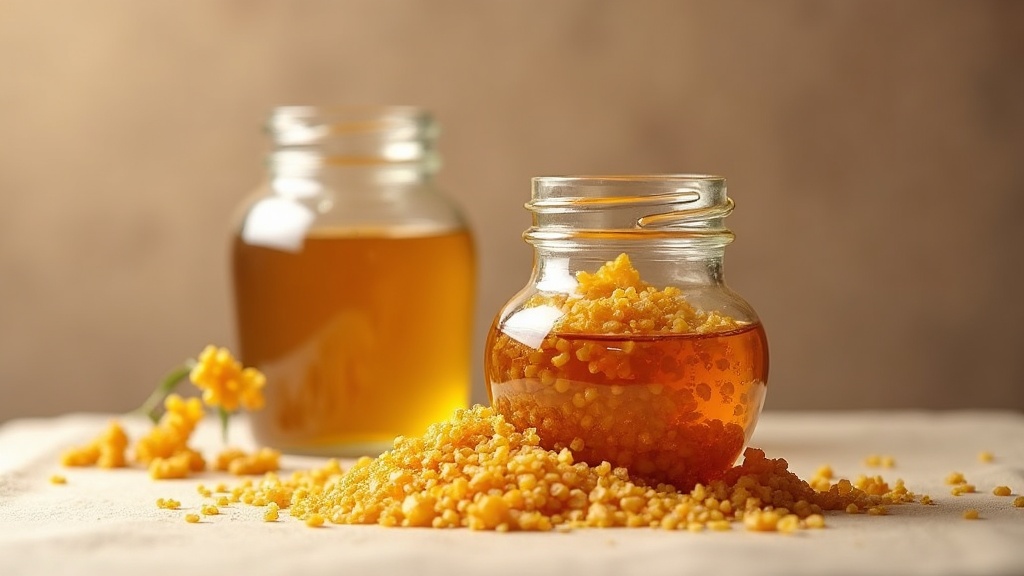
Long before quick fixes and trending powders, women leaned on slower kitchen traditions. The Biblical drink (oil)/ Honey blend is one of those old rituals — built around simple pantry ingredients, patience, and a bit of ancestral common sense.
Before talking about any ritual, it helps to understand what’s really shifting underneath the surface — starting with why the Biblical drink (oil)/ Honey blend caught so many women’s attention in the first place.
Collagen is the structural protein behind skin elasticity and joint comfort, and the body's natural output gradually declines with age — often before we notice any outward sign.
The hormones that tell your brain 'I'm full' don't always speak as clearly as they used to, which can make portion awareness feel like a moving target.
Body composition — the ratio of lean tissue to everything else — tends to change quietly over the years, independent of what the scale says.
Generic calorie-counting advice was rarely designed with female physiology in mind, which is part of why so many women feel like the old rules just don't apply anymore.
There’s a lot of noise online about metabolism and weight. Here’s a grounded, no-hype look at three common claims.
Metabolism is fixed the moment you hit a certain age.
Metabolic rate is influenced by many factors — muscle mass, sleep, stress, and daily habits all play a role, not just the calendar.
Feeling less full after meals means something is broken.
Satiety signaling is complex and can shift for many reasons; it’s a normal part of physiology, not a personal failure.
Any ‘natural remedy’ works the same for every woman.
Bodies, habits, and starting points differ. What a tradition like the Biblical drink (oil)/ Honey blend represents is a habit, not a one-size-fits-all fix.
No complicated routine here — just three small steps that fit into an already busy morning.
The ritual begins with a simple warm liquid base, combined with a small amount of natural honey — nothing exotic, nothing hard to find.
Rather than creating a new habit from scratch, many women fold this into something they already do each morning, like their coffee or tea moment.
Traditions like this were never about one dramatic day — they were about showing up in a small, repeatable way over time.
Honey-and-oil combinations show up across generations of home kitchens, often passed down alongside gelatin-rich broths and slow-cooked bone stocks. Long before ‘collagen’ was a marketing word, grandmothers were simmering skins and joints into meals, and finishing them with a spoonful of honey. The Biblical drink (oil)/ Honey blend sits at that same intersection — old ingredients, old patience, revisited by modern women looking for something less complicated.
The interesting part isn’t the ingredients themselves — it’s that these traditions were always built around consistency, not intensity.
Feeling hungry again shortly after eating a full meal can be a sign that satiety signaling deserves more attention.
Changes in skin firmness or texture are often connected to the body's natural collagen turnover.
Mild joint stiffness, especially later in the day, is one of the more commonly overlooked everyday signals.
Fluctuations that don't match diet or activity changes are worth paying attention to, not ignoring.
A predictable afternoon slump can point to how meals and habits are structured throughout the day.
Nail strength is often one of the first small things women notice changing, even before anything else.
These are individual experiences shared for illustrative purposes only. Individual results may vary, and testimonials are not a guarantee of similar outcomes for every reader.
Hydrolyzed gelatin is gelatin that has been broken down into smaller components, which some traditional food and drink preparations use as an ingredient. It’s derived from the same collagen-rich sources found in slow-cooked broths.
It refers to a traditional preparation combining a base oil and honey, inspired by old culinary customs rather than any modern supplement formula.
No. This page discusses a traditional habit and educational information about female physiology — it does not make any weight-loss or treatment claims.
No. The idea behind this tradition is that it’s a small addition to an existing routine, not a full diet overhaul.
Every woman’s body and health circumstances are different. It’s always best to speak with a healthcare professional before adding anything new to your routine.
Honey-and-oil combinations and gelatin-rich cooking traditions have appeared across generations of home kitchens, long before modern wellness trends existed.
You can continue to the next page for a more detailed look at the story, the ingredients, and how women are incorporating this habit into daily life.
See the full story behind the Biblical drink (oil)/ Honey blend and how women are folding it into routines they already have.
Advertising Disclosure: This page contains sponsored content and affiliate links. We may receive compensation if you choose to purchase through links on this page, at no additional cost to you. This compensation helps support our editorial work and allows us to continue producing content.
Content Disclaimer: The content on this page is for educational and informational purposes only. It is not intended to diagnose, treat, cure, or prevent any disease. These statements have not been evaluated by the Food and Drug Administration. Always consult a qualified healthcare professional before making any changes to your diet, exercise routine, or overall wellness plan.
Results Disclaimer: Individual results may vary. The testimonials and experiences shared on this page are personal accounts and are not a guarantee of similar outcomes for every reader. Always consult a healthcare professional regarding your own individual circumstances.
© 2026 All Rights Reserved · Privacy Policy · Refund Policy · Shipping · Contact · Disclaimer